



Find the best tutors and institutes for Class 10 Tuition
Q8:
A quadrilateral $ABCD$ is drawn to circumscribe a circle (see Fig. 10.12). Prove that $AB + CD = AD + BC$.
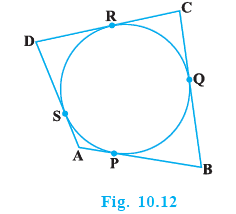
A quadrilateral $ABCD$ is drawn to circumscribe a circle (see Fig. 10.12). Prove that $AB + CD = AD + BC$.
Solution :
Given: A quadrilateral $ABCD$ circumscribing a circle with center $O$. The circle touches the sides $AB$, $BC$, $CD$, and $DA$ at points $P$, $Q$, $R$, and $S$ respectively.
To Prove: $AB + CD = AD + BC$
Step 1: Applying the Tangent Theorem
We use the theorem: The lengths of tangents drawn from an external point to a circle are equal.
Considering the external points $A, B, C,$ and $D$:
1. From point $A$: $AP = AS$ --- (Equation 1)
2. From point $B$: $BP = BQ$ --- (Equation 2)
3. From point $C$: $CQ = CR$ --- (Equation 3)
4. From point $D$: $DR = DS$ --- (Equation 4)
Step 2: Summing the Equations
Adding Equations 1, 2, 3, and 4 together:
$AP + BP + CQ + DR = AS + BQ + CR + DS$
Step 3: Rearranging the Terms
Group the segments that form the sides of the quadrilateral:
$(AP + BP) + (CQ + DR) = (AS + DS) + (BQ + CR)$
Step 4: Substituting Side Lengths
Based on the geometry of the quadrilateral:
$AP + BP = AB$
$CQ + DR = CD$
$AS + DS = AD$
$BQ + CR = BC$
Substituting these into the equation from Step 3:
$AB + CD = AD + BC$
Conclusion:
Since the sum of the lengths of opposite sides is equal, the identity is proven.
Final Answer: Hence, it is proved that $AB + CD = AD + BC$.
More Questions from Class 10 Mathematics Circles EXERCISE 10.2
- Q1: Choose the correct option and give justification. From a point $Q$, the length of the tangent to a circle is $24$ cm and the distance of $Q$ from the centre is $25$ cm. The radius of the circle is
- Q10: Prove that the angle between the two tangents drawn from an external point to a circle is supplementary to the angle subtended by the line-segment joining the points of contact at the centre.
- Q11: Prove that the parallelogram circumscribing a circle is a rhombus.
- Q12: A triangle $ABC$ is drawn to circumscribe a circle of radius $4$ cm such that the segments $BD$ and $DC$ into which $BC$ is divided by the point of contact $D$ are of lengths $8$ cm and $6$ cm respectively (see Fig. 10.14). Find the sides $AB$ and $AC$.
- Q13: Prove that opposite sides of a quadrilateral circumscribing a circle subtend supplementary angles at the centre of the circle.
- Q2: Choose the correct option and give justification. In Fig. 10.11, if $TP$ and $TQ$ are the two tangents to a circle with centre $O$ so that $\angle POQ = 110^{\circ}$, then $\angle PTQ$ is equal to
- Q3: Choose the correct option and give justification. If tangents $PA$ and $PB$ from a point $P$ to a circle with centre $O$ are inclined to each other at angle of $80^{\circ}$, then $\angle POA$ is equal to
- Q4: Prove that the tangents drawn at the ends of a diameter of a circle are parallel.
- Q5: Prove that the perpendicular at the point of contact to the tangent to a circle passes through the centre.
- Q6: The length of a tangent from a point $A$ at distance $5$ cm from the centre of the circle is $4$ cm. Find the radius of the circle.
- Q7: Two concentric circles are of radii $5$ cm and $3$ cm. Find the length of the chord of the larger circle which touches the smaller circle.
- Q9: In Fig. 10.13, $XY$ and $X'Y'$ are two parallel tangents to a circle with centre $O$ and another tangent $AB$ with point of contact $C$ intersecting $XY$ at $A$ and $X'Y'$ at $B$. Prove that $\angle AOB = 90^{\circ}$.


