



Find the best tutors and institutes for Class 9 Tuition
Q4:
Classroom activity (Constructing the ‘square root spiral’) : Take a large sheet of paper and construct the ‘square root spiral’ in the following fashion. Start with a point $O$ and draw a line segment $OP_1$ of unit length. Draw a line segment $P_1P_2$ perpendicular to $OP_1$ of unit length (see Fig. 1.9). Now draw a line segment $P_2P_3$ perpendicular to $OP_2$. Then draw a line segment $P_3P_4$ perpendicular to $OP_3$. Continuing in this manner, you can get the line segment $P_{n-1}P_n$ by drawing a line segment of unit length perpendicular to $OP_{n-1}$. In this manner, you will have created the points $P_2, P_3,...., P_n,...$ ., and joined them to create a beautiful spiral depicting $\sqrt{2}, \sqrt{3}, \sqrt{4}, ...$
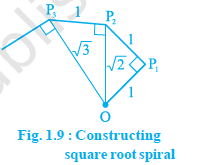
Classroom activity (Constructing the ‘square root spiral’) : Take a large sheet of paper and construct the ‘square root spiral’ in the following fashion. Start with a point $O$ and draw a line segment $OP_1$ of unit length. Draw a line segment $P_1P_2$ perpendicular to $OP_1$ of unit length (see Fig. 1.9). Now draw a line segment $P_2P_3$ perpendicular to $OP_2$. Then draw a line segment $P_3P_4$ perpendicular to $OP_3$. Continuing in this manner, you can get the line segment $P_{n-1}P_n$ by drawing a line segment of unit length perpendicular to $OP_{n-1}$. In this manner, you will have created the points $P_2, P_3,...., P_n,...$ ., and joined them to create a beautiful spiral depicting $\sqrt{2}, \sqrt{3}, \sqrt{4}, ...$
Solution :
Theoretical Foundation: The Pythagorean Theorem
The construction of the "square root spiral" (historically known as the Spiral of Theodorus) is predicated on the sequential application of the Pythagorean theorem in contiguous right-angled triangles. For any right-angled triangle with legs $a$ and $b$, and hypotenuse $c$, the theorem states:
$c^2 = a^2 + b^2 \implies c = \sqrt{a^2 + b^2}$
By maintaining one leg at a constant unit length ($1$) and using the hypotenuse of the previous triangle as the second leg, we generate a sequence of hypotenuses whose lengths are the square roots of consecutive natural numbers ($\sqrt{2}, \sqrt{3}, \sqrt{4}, \dots$).
Step 1: Constructing the Base Triangle for $\sqrt{2}$
- Define an origin point $O$.
- Draw a horizontal line segment $OP_1$ such that its length is exactly $1$ unit.
- At point $P_1$, construct a perpendicular line segment $P_1P_2$ such that $P_1P_2 \perp OP_1$ and the length of $P_1P_2 = 1$ unit.
- Join $O$ to $P_2$ to form the right-angled triangle $\triangle OP_1P_2$.
[Per the Pythagorean Theorem]:
$OP_2 = \sqrt{OP_1^2 + P_1P_2^2} = \sqrt{1^2 + 1^2} = \sqrt{2} \text{ units}$
Step 2: Constructing the Triangle for $\sqrt{3}$
- Using $OP_2$ (which has a length of $\sqrt{2}$) as the new base, construct a line segment $P_2P_3$ perpendicular to $OP_2$ at point $P_2$.
- Ensure the length of $P_2P_3 = 1$ unit.
- Join $O$ to $P_3$ to form the right-angled triangle $\triangle OP_2P_3$.
[Per the Pythagorean Theorem]:
$OP_3 = \sqrt{OP_2^2 + P_2P_3^2} = \sqrt{(\sqrt{2})^2 + 1^2} = \sqrt{2 + 1} = \sqrt{3} \text{ units}$
Step 3: Constructing the Triangle for $\sqrt{4}$ and Generalization
- Using $OP_3$ (length $\sqrt{3}$) as the base, construct $P_3P_4 \perp OP_3$ with a length of $1$ unit.
- Join $O$ to $P_4$.
$OP_4 = \sqrt{OP_3^2 + P_3P_4^2} = \sqrt{(\sqrt{3})^2 + 1^2} = \sqrt{3 + 1} = \sqrt{4} = 2 \text{ units}$
General Mathematical Induction:
Continuing this process for the $n$-th iteration, we draw a unit segment $P_{n-1}P_n$ perpendicular to the previous hypotenuse $OP_{n-1}$. The length of the new hypotenuse $OP_n$ will always be:
$OP_n = \sqrt{(\sqrt{n-1})^2 + 1^2} = \sqrt{n-1 + 1} = \sqrt{n}$
Step 4: Geometric Construction Protocol (Classroom Execution)
To physically construct this on a large sheet of paper, execute the following precise steps:
- Mark the Origin: Choose a point $O$ near the center of the paper.
- Set the Unit Scale: Define a standard unit length (e.g., $1 \text{ unit} = 3 \text{ cm}$ or $1 \text{ inch}$) to ensure the spiral is large and legible. Draw $OP_1$.
- Use a Protractor/Set Square: Place the baseline of the protractor on $OP_1$ with the center at $P_1$. Mark $90^\circ$. Draw a line through $P_1$ and cut it at $1$ unit to locate $P_2$.
- Connect and Repeat: Draw $OP_2$. Align the protractor baseline along $OP_2$ with the center at $P_2$. Mark $90^\circ$, draw a $1$-unit segment to locate $P_3$. Draw $OP_3$.
- Iterate: Repeat this process continuously. The outer vertices $P_1, P_2, P_3, \dots, P_n$ will trace the path of the square root spiral.
High-Precision Geometric Visualization
Below is a mathematically exact, coordinate-mapped rendering of the square root spiral up to $P_7$ ($\sqrt{7}$). All angles and lengths are calculated via trigonometric functions to ensure absolute spatial truth.
Final Solution: By iteratively constructing right-angled triangles where one leg is always $1$ unit and the other leg is the hypotenuse of the preceding triangle, the lengths of the successive hypotenuses radiating from the origin $O$ mathematically generate the sequence $\sqrt{1}, \sqrt{2}, \sqrt{3}, \sqrt{4}, \dots, \sqrt{n}$, forming the square root spiral.
More Questions from Class 9 Mathematics Number Systems EXERCISE 1.2
- Q1(i): State whether the following statements are true or false. Justify your answers. (i) Every irrational number is a real number.
- Q1(ii): State whether the following statements are true or false. Justify your answers. (ii) Every point on the number line is of the form $\sqrt{m}$, where $m$ is a natural number.
- Q1(iii): State whether the following statements are true or false. Justify your answers. (iii) Every real number is an irrational number.
- Q2: Are the square roots of all positive integers irrational? If not, give an example of the square root of a number that is a rational number.
- Q3: Show how $\sqrt{5}$ can be represented on the number line.


