



Find the best tutors and institutes for Class 10 Tuition
Q9:
A wooden article was made by scooping out a hemisphere from each end of a solid cylinder, as shown in Fig. 12.11. If the height of the cylinder is $10$ cm, and its base is of radius $3.5$ cm, find the total surface area of the article.
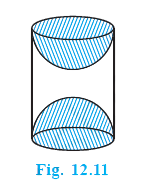
A wooden article was made by scooping out a hemisphere from each end of a solid cylinder, as shown in Fig. 12.11. If the height of the cylinder is $10$ cm, and its base is of radius $3.5$ cm, find the total surface area of the article.
Solution :
Given:
- Height of the solid cylinder ($h$) = $10$ cm
- Radius of the base of the cylinder ($r$) = $3.5$ cm
- The article is formed by scooping out a hemisphere from each end of the cylinder.
To Find:
The total surface area of the resulting wooden article.
Step 1: Understanding the Surface Area Components
The total surface area of the article consists of three parts:
- The Curved Surface Area (CSA) of the cylinder.
- The Curved Surface Area (CSA) of the top hemisphere.
- The Curved Surface Area (CSA) of the bottom hemisphere.
Formulae to be used:
- CSA of cylinder = $2\pi rh$
- CSA of a hemisphere = $2\pi r^2$
Step 2: Setting up the Equation
Total Surface Area (TSA) = (CSA of cylinder) + (CSA of top hemisphere) + (CSA of bottom hemisphere)
$TSA = 2\pi rh + 2\pi r^2 + 2\pi r^2$
$TSA = 2\pi rh + 4\pi r^2$
$TSA = 2\pi r(h + 2r)$
Step 3: Substituting the Values
Given $r = 3.5$ cm and $h = 10$ cm.
$TSA = 2 \times \frac{22}{7} \times 3.5 \times (10 + 2 \times 3.5)$
[Since $\pi \approx \frac{22}{7}$]
Step 4: Performing the Calculation
First, simplify the radius term: $3.5 = \frac{7}{2}$
$TSA = 2 \times \frac{22}{7} \times \frac{7}{2} \times (10 + 7)$
$TSA = 2 \times \frac{22}{7} \times \frac{7}{2} \times (17)$
Cancel the common factors ($2$ and $7$):
$TSA = 22 \times 17$
$TSA = 374$
Step 5: Final Conclusion
The total surface area is calculated in square centimeters ($cm^2$).
Final Answer: 374 cm²
More Questions from Class 10 Mathematics Surface Areas and Volumes EXERCISE 12.1
- Q1: 2 cubes each of volume $64$ cm$^3$ are joined end to end. Find the surface area of the resulting cuboid.
- Q2: A vessel is in the form of a hollow hemisphere mounted by a hollow cylinder. The diameter of the hemisphere is $14$ cm and the total height of the vessel is $13$ cm. Find the inner surface area of the vessel.
- Q3: A toy is in the form of a cone of radius $3.5$ cm mounted on a hemisphere of same radius. The total height of the toy is $15.5$ cm. Find the total surface area of the toy.
- Q4: A cubical block of side $7$ cm is surmounted by a hemisphere. What is the greatest diameter the hemisphere can have? Find the surface area of the solid.
- Q5: A hemispherical depression is cut out from one face of a cubical wooden block such that the diameter $l$ of the hemisphere is equal to the edge of the cube. Determine the surface area of the remaining solid.
- Q6: A medicine capsule is in the shape of a cylinder with two hemispheres stuck to each of its ends (see Fig. 12.10). The length of the entire capsule is $14$ mm and the diameter of the capsule is $5$ mm. Find its surface area.
- Q7: A tent is in the shape of a cylinder surmounted by a conical top. If the height and diameter of the cylindrical part are $2.1$ m and $4$ m respectively, and the slant height of the top is $2.8$ m, find the area of the canvas used for making the tent. Also, find the cost of the canvas of the tent at the rate of $₹ 500$ per m$^2$. (Note that the base of the tent will not be covered with canvas.)
- Q8: From a solid cylinder whose height is $2.4$ cm and diameter $1.4$ cm, a conical cavity of the same height and same diameter is hollowed out. Find the total surface area of the remaining solid to the nearest cm$^2$.
CBSE Solutions for Class 10 Mathematics Surface Areas and Volumes
Chapters in CBSE - Class 10 Mathematics

Download free CBSE - Class 10 Mathematics Surface Areas and Volumes EXERCISE 12.1 worksheets
Download Now
